Thursday, July 1, 2010

Trinidad's PM breaks the cultural mould

Following her election victory, continuing to break the glass ceiling


Trinidad's PM breaks the cultural mould

By Nazma Muller
Trinidad
Published
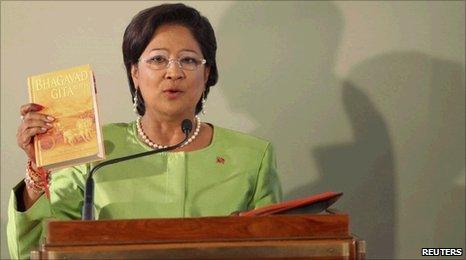
Ms Persad-Bissessar holds the Gita as she takes the oath of office in Port of Spain 27/05/2010
Image caption,
Ms Persad-Bissessar is a devout Hindu

Barely 24 hours after she was sworn in as the first woman prime minister of Trinidad and Tobago, Kamla Persad-Bissessar donned a life jacket and waded into the flood waters to tour areas affected by torrential rains sweeping across the Caribbean.

A devout Hindu, she swore on the Bhagavad Gita - the Hindu holy book - to do her duty to her people.

Even as congratulations poured in from around the world, she remained focused on "dealing with the people's business".

It was the most important task at hand, she told her 1.3m citizens during the live televised address of her historic swearing-in ceremony.

A descendant of Indian indentured labourers who came to Trinidad to work the sugar plantations from Uttar Pradesh and Bihar between 1845 and 1917, Ms Persad-Bissessar grew up with traditional Indian values and strong religious ties.

'No novice'

The landslide victory of the coalition led by her United National Congress (UNC) party in last month's election has brought a sense of euphoria and feeling of hope to this incredibly wealthy republic.

Trinidad and Tobago has sailed smoothly through the global recession, cushioned by a sea of oil and natural gas.
A woman walks past graffiti promoting Ms Persad-Bissessar in Port of Spain on 23/05/2010
Image caption,
Ms Persad-Bissessar ran a high-profile election campaign

The squandering of billions of dollars by the former government and alleged corruption helped bring this 58-year-old grandmother-of-two into power.

She unseated former PM Patrick Manning whose People's National Movement (PNM) party had governed the country for 42 of the 48 years since its independence from the UK.

An attorney by profession, Ms Persad-Bissessar is no novice to politics having been the MP for her area Siparia, a rural town in the south of the island, since 1995.

In the last 15 years she has weathered many political storms, even as she broke gender barriers.

Former Prime Minister Basdeo Panday (1995-2001) appointed her attorney general and education minister during the UNC's first stint in office, and she even acted as PM.

But in 2007, in the lead-up to a general election, when it was clear that she was the best person to lead the party, Mr Panday refused to resign.

Ms Persad-Bissessar, who is married to a doctor and has a son, swallowed the humiliation, even giving a famous speech to the theme of Bob Marley's No Woman No Cry, in which she declared her undying support for her political guru.

But all that changed last December.

As then Prime Minister Manning became increasingly unpopular, Ms Persad-Bissessar saw a golden opportunity for the opposition forces to unite to topple the ruling People's National Movement.

'Smear campaign'

But as she launched her bid to take over the UNC, Mr Panday unleashed an attack on her reputation, suggesting that she was an alcoholic.

Ms Persad-Bissessar called the accusation "total falsehood".
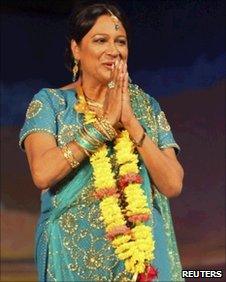
Ms Persad-Bissessar is of Indian origin
Image caption,
Ms Persad-Bissessar is of Indian origin

"It is a smear campaign of lies, half-truths and innuendoes. Smear campaigns do not win elections. Sticks and stones may break my bones but words cannot hurt me."

Indeed, they did not.

On 24 January, Ms Persad-Bissessar became leader of the UNC with a landslide victory.

When Mr Panday refused to step down as leader of the opposition, she dealt with that too - persuading his loyal MPs to cross over to her side.

After she was appointed leader of the opposition, she hired the strategist who worked on Barack Obama's presidential campaign to assist her.

After a blistering, hugely expensive campaign that used high-tech, slick advertisement in all the media, including the internet, Ms Persad-Bissessar and her coalition emerged victorious.

And on 24 May she became prime minister.

Ms Persad-Bissessar has shown admirable political savvy in the last few weeks, openly courting the media and reacting swiftly to public opinion.

In her 30 May Indian Arrival Day speech she touched on "soft" issues such as race, gender and class inequality.

"As a child in the rural district of Penal I remember sharing meals from the same pot with neighbours of different racial, ethnic, social and economic backgrounds," she said.

"We all managed. If one had, then all had. Because then we were intuitively and instinctively our brother's keepers.

On her terms

"Time and circumstances have allowed many factors, including the divisiveness of some politicians, to keep us apart. But to go forward, we must go back.

"We need to rekindle those values, those strengths as a nation and as a people… And we must do so as one people with one goal."
Trinidad and Tobago's former Prime Minister Patrick Manning
Image caption,
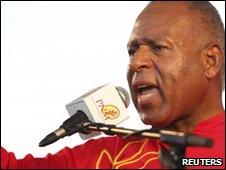
Ms Persad-Bissessar unseated former PM Patrick Manning

She is intensely aware of the chance she has to make and change history on these islands.

She has already shown that she will be a prime minister on her own terms.

She declined the opportunity to meet US Secretary of State Hillary Clinton because parliament had not yet been convened.

She graced the catwalk at Trinidad and Tobago's annual fashion week at the end of May.

And she also made an appearance with local chutney musicians at a show.

Ms Persad-Bissessar, who graduated top of her class from law school, also confronted the delicate issue of gender tensions.

"Looking towards the future, one of the most important issues the national community must face is the widening gap between the liberated, modern, independent women and our traditional men who are being left behind," she said.

"Women are outperforming men in almost every sphere of life in our society and the women of east Indian ancestry are no exception to this rule. They have broken the cultural mould," she said.

No-one as much as her.

From
BBC News - Trinidad's PM breaks the cultural mould

Call for Papers: Placing the Archipelago « Repeating Islands

Grow Safeguard Preserve Create A MultiMedia Legacy

With rapidly changing technologies in media, many of our knowledge resources are fast disappearing or becoming inaccessible. We are in the process of digitising our archives representing more than 30 years of contemporary Caribbean development linked to more than 10,000 years of regional pre and post colonial history and heritage. Make contact.

To support, sponsor, collaborate and partners with our digitisation efforts. Or to develop your own legacy initiatives, and safeguard, preserve, multimedia museum, galleries, archives, make contact.


Call for Papers: Placing the Archipelago « Repeating Islands

Tuesday, June 29, 2010

Gender Empowerment Resources booklet

Grow Safeguard Preserve Create A MultiMedia Legacy

With rapidly changing technologies in media, many of our knowledge resources are fast disappearing or becoming inaccessible. We are in the process of digitising our archives representing more than 30 years of contemporary Caribbean development linked to more than 10,000 years of regional pre and post colonial history and heritage. Make contact.

To support, sponsor, collaborate and partners with our digitisation efforts. Or to develop your own legacy initiatives, and safeguard, preserve, multimedia museum, galleries, archives, make contact.


gender_booklet_en.pdf (application/pdf Object)

Book traces T&T PM’s road to victory | NationNews - Barbados


Book traces T&T PM’s road to victory | NationNews - Barbados

Put hold on same sex school project

Put hold on same sex school project

In a press release, the Network’s international relations director Dr Kris Rampersad said separation into single gender schools may simply delay the problems that this solution is expected to address. She called for more long term solutions to be implemented.

The network also agreed with TTUTA that the decision to implement the same sex schools pilot project was made without consultation. “A proper gender policy can give context and rationality to the debate and plans for same sex education, if it is done with adequate public consultation and with all the necessary apparatus in place that will ensure an improvement in our education system,” Dr Rampersad said.

Rampersad reasoned that separation of boys and girls will not solve problems encountered in schools, which includes the underachievement of males, unless there is proper understanding of gender differences in how students learn.

“Same sex education may also have little effect if the many other ills in the education system and social ills are not addressed. These include irrelevant and outdated teaching methods, use of alien and imported teaching materials and misdirected teacher training. We support any system that allow and facilitate girls and boys to explore their full potential, but clearly not quick fix and stop gap approaches,” she said.


Trinidad and Tobago's Newsday : newsday.co.tt :

Monday, June 28, 2010

Convention 2011 - Northeast Modern Language Association (NeMLA)

Convention 2011 - Northeast Modern Language Association (NeMLA)

Wednesday, June 23, 2010

opm45.pdf (application/pdf Object)

opm45.pdf (application/pdf Object)

CARIBARTS - The Home of Caribbean Arts & Culture

CARIBARTS - The Home of Caribbean Arts & Culture

Women still face political glass ceiling - in all parties

Grow Safeguard Preserve Create A MultiMedia Legacy

With rapidly changing technologies in media, many of our knowledge resources are fast disappearing or becoming inaccessible. We are in the process of digitising our archives representing more than 30 years of contemporary Caribbean development linked to more than 10,000 years of regional pre and post colonial history and heritage. Make contact.

To support, sponsor, collaborate and partners with our digitisation efforts. Or to develop your own legacy initiatives, and safeguard, preserve, multimedia museum, galleries, archives, make contact.


Next Left: Women still face political glass ceiling - in all parties

Kris Rampersad — Blogs, Pictures, and more on WordPress

Kris Rampersad — Blogs, Pictures, and more on WordPress

Kris Rampersad — Blogs, Pictures, and more on WordPress

Kris Rampersad — Blogs, Pictures, and more on WordPress

As Cool as Gokool Haji Gokool Meah

Featured in Finding A Place by Dr Kris Rampersad

Haji Gokool Meah 

How many of us would have known that the expression “cool as Gokool” referred to Haji Gokool Meah (1847-1939) who came on an indenture ship when he was just six years old and grew to be businessman, cocoa proprietor and cinema magnate, builder of the Globe and Empire cinemas in the 1930’s? Gokool drank his cup of dhal every day, and in the face of racial prejudice conducted his business with an icy calm that became proverbial, hence “cool as Gokool”. [Extracted from Caribbean History Archives]

BIOGRAPHICAL SKETCH

Haji Gokool Meah (1847–1939) was an industrialist and philanthropist. He was born in Kashmir, in what was then British India. He was originally named Modhoo. His father died shortly before his birth and his mother remarried.

As a small child, his family left Kashmir and ended up in Calcutta where in 1852 they signed up as indentured labourers bound for the sugar cane fields of Trinidad. On January 25, 1853 they arrived in Trinidad aboard the Benares. They were indentured at the Concord Estate in Pointe-à-Pierre. After three months, his mother died of malaria and his stepfather took little interest in him. He was informally adopted by a Hindu couple who gave him the name Gokool.

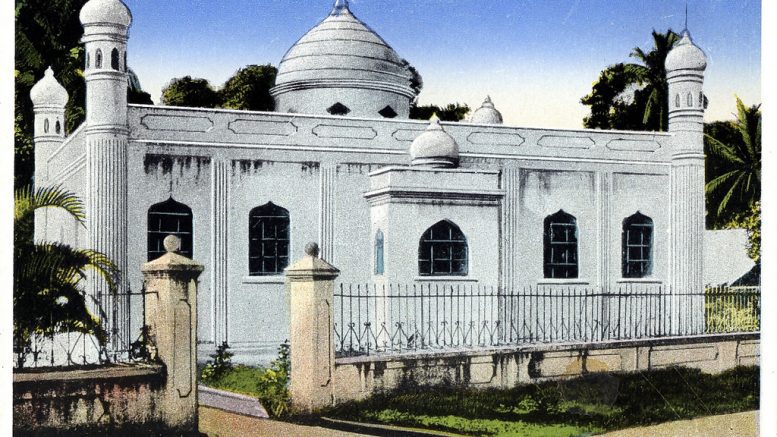
Haji Gokool Meah Mosque

Once he was old enough, Gokool secured his own indentureship contract with the Concord Estate. He renewed his contract once it expired, and then went out on his own. He purchased a donkey cart and made a living hauling sugar cane to the factory at Usine Sainte Madeline, then the second largest sugar refinery in the world. After a few years of this trade, he sold his cart and established a shop in Danglade Village on the road to San Fernando (now part of the Petrotrin oil refinery at Pointe-à-Pierre).

He married Rojan Boodhoo, a Muslim in 18781, and had 17 children, 11 of whom survived. From shopkeeping he moved on to cocoa cultivation, establishing one of the early cocoa plantations in the Diego Martin valley. From cocoa he moved on the real estate, becoming one of the major landlords in Port of Spain. He also established himself as a cinema magnate, establishing the Metro cinema in collaboration with MGM. He later split with them and renamed his cinema the Globe Cinema, eventually operating a string of five cinemas in Port of Spain and San Fernando.

In 1922 he performed the Haj (Muslim pilgrimage to Mecca). In his will, he established the Haji Gokool Meah Trust, a trust to continue the charitable works which had earned him the title Meah (benefactor). [Extracted from Wikipedia]  In 1923 he joined Kazi Syed Abdul Aziz, Haji Ruknuddin Meah and Abdul Ghany to set up the TIA, and was a generous donor to their projects.   When he died he left $1million in a tust fund to his son Noor to administer to the poor.  Noor passed it on to an institution which established the Haji Gokool Meah Trust Fund in 1967 for the poor, needy and education in general, then valued at $1.93 million.1

The Cinema

On Thursday February 2nd 1911, Trinidadians got their first taste of the new-fangled technology of moving pictures. The London Electric Theatre was constructed at the corner of Baden Powell St. and French St. in Woodbrook. Built by Marcus and Reginal Davis, the opening was eagerly anticipated as crowds braved a rainy evening to see the first show, entitled “The World Before Your Eyes” . The matinée was a series of stills, rapidly flipped before a projector to give the illusion of motion. The rates charged for admission were for the gender and age classes, and not for house or balcony as with later cinemas.

Another pioneer in the local cinema industry was Gokool Meah. Born in 1848 in Kashmir, he came as a child to Trinidad, and was subsequently orphaned with the deaths of his parents, Caulloo and Puddoo. Adopted by a childless Hindu couple, who did not mind the waif’s Islamic heritage, he grew up in labour on Concord Estate, near Pointe-a-Pierre, then owned by Dr. J.B Phillippe, a prominent coloured medical man and well-known public figure.

By 1870 he was driving a mule cart, and later bought one of his own with which he did a thriving trade, carting canes to the refinery at Usine Ste. Madeline. His career as a carter abruptly ended when the mule kicked him, and using his savings, Gokool opened a small shop near the estate.

In 1878 he married a young Punjabi woman, Rojan, who gave him 11 surviving children. The shop prospered and in 1892, Gokool was able to purchase Diamond, Greenhill and River Estates, comprising almost the whole Diego Martin valley, which he developed as cocoa plantations. He moved there with his family and lived in a large wooden house. His children were educated in the local R.C School, with the boys going on to prestige secondary schools in POS.

By 1918, Gokool was buying up properties in POS which were going cheap in the post WWI recession. Although known as a hard commercial man, he was a charitable, pious Muslim, who fed children at his home daily and gave a piece of land to be used as an Indian cemetery in Diego Martin.

In 1922 he made a pilgrimage to Mecca with his son Noor, and became known as Haji Gokool Meah. In 1927 he built a Masjid in St. James which bears his name. In 1933, Gokool dived feet first into the cinema business, where fellow Indians, Timothy Roodal and Sarran Teelucksingh had already made a fortune. He was particularly convinced when the first movie with sound, a ‘talkie’ was shown in 1930. Gokool, supported by his son Noor (business manager of the vast empire his father owned and a QRC grad) forged an alliance with the American film producer, Metro Goldwyn Mayer, MGM. The contract was so planned that Gokool could only show films produced by MGM.

In 1933 , he constructed at the corner of St. Vincent and Park Sts. the Metro Cinema. It opened on March 19th 1933 to huge fanfare and for good reason. The ornate classical building could seat over 1,000 patrons in balcony and pit, and cost over $80,000 to construct. By comparison, almost the whole of modern-day Aranguez was for sale at the time for $22,000.00 The Globe was also the first building in Trinidad to be air-conditioned, and the largest cinema in the Caribbean. It also had a stage for live theatrical performances.

In 1938, Gokool breached his contract with MGM by showing films from rival outfits like RKO and Paramount. MGM withdrew and signed with George Rosenthal, another cinema pioneer. Gokool changed the name of his cinema to Globe, which name it still carries today. He also opened other Globe cinemas in Princes Town and Chaguanas. Not above a little bobol from time to time, Gokool tried to burn down one of his properties for insurance, sending his son Anware to do the deed… the boy was caught and fined. “Insuranburn”, as Sir V.S Naipaul called it, was a popular crooked business practice at the time.  Gokool died in 1940 aged 92. The cinema he founded is still extant in its original building and is a gem of period architecture.

The Cinema – contributed by

Angelo Bissessarsingh Siparia  adapted from 

1. Finding a Place by Kris Rampersad
2. http://www.naturetrektt.com/Trekking/25ThingsNotToMissAtAll/StJames/tabid/513/Default.aspx


Featured in Finding A Place. Help Us digitise

Grow Safeguard Preserve Create A MultiMedia Legacy


Featured in Finding A Place. Help Us digitise

Grow Safeguard Preserve Create A MultiMedia Legacy

With rapidly changing technologies in media, many of our knowledge resources are fast disappearing or becoming inaccessible. We are in the process of digitising our archives representing more than 30 years of contemporary Caribbean development linked to more than 10,000 years of regional pre and post colonial history and heritage. Make contact.

To support, sponsor, collaborate and partners with our digitisation efforts. Or to develop your own legacy initiatives, and safeguard, preserve, multimedia museum, galleries, archives, make contact.

Haji Gokool Meah (1847 - 1939) in Caribbean Muslims 

UPR RP English Department --Student resources: Islands in Between

UPR RP English Department --Student resources: Islands in Between

Thursday, June 17, 2010

Trinidad and Tobago's Newsday : newsday.co.tt :

Trinidad and Tobago's Newsday : newsday.co.tt :

Wednesday, June 16, 2010

It's 'business unusual'... Triple whammy to hit energy sector | On the Frontlines of Climate Change

It's 'business unusual'... Triple whammy to hit energy sector | On the Frontlines of Climate Change

Triple whammy to hit energy sector

Byline Author: 
Article Date: 
Sunday, April 19, 2009
• Rising resource costs • Rising energy costs • Rising food prices
It’s ‘business unusual’...
For the energy sector, it is not “business as usual,” not only because of supply factors, but also related to focus on more efficient and sustainable uses of energy and climate change-related issues. This is the message from energy researchers, ColinDale Marcelle and Ian Ivey, as heads of governments and policy-makers discuss the global financial crisis at the Fifth Summit of the Americas. “The energy sector does not operate in isolation. The major trends shaping its ‘big picture’ future are coming together for a ‘triple whammy’ effect—rising energy costs, rising food prices and rising resource costs,” said Ivey, of the research group NEXT.
“T&T needs to become far more focused on the opportunities associated with the entire renewable energy sector, because it has invested heavily in the development of considerable expertise in the energy field. “Once the country’s oil and gas fields enter into a decline phase—which may be little more than a decade away—that investment will have little long-term value to the country, unless it is redirected towards future rapid growth opportunity areas in the ‘new energy’ scene. “It is clearly going to be difficult for a small country such as T&T to be an internationally cost-competitive player in renewable energy sectors, such as bio-ethanol and bio-diesel, as the land areas required are vast and the throughput volumes required to justify the capital investments needed are potentially large.
Along with Marcelle, Ivey is the co-author of the recently released Global Foresight Review on renewable energy and Renewable Energy Best Bets Opportunities for T&T (see Niherst.gov.tt), which focus on opportunities and alternatives for T&T outside the oil and gas sector. They were prepared by NEXT Corporation for the National Institute of Higher Education Research, Science and Education.
Increase by 2030
Foresight and innovation research identified several “best bets” for T&T’s energy sector that would lead to greater efficiency in use of existing energy sources and develop businesses built around alternative energy generated from environment-friendly renewable sources. Nine initial potential “best bets” were identified, including developing alternative energy sources by harnessing the power of wave, wind, solar and volcanic energy and growing business by tapping into existing research and technologies. “The potential ‘best bet’ opportunity areas identified could provide the basis of a significant new energy sector focus in T&T,” the authors say. The top three involved use of bio-gas, solar and energy-efficient technologies.
The Global Review cites trends and issues that have an impact on energy markets that point to higher prices for crude oil and natural gas, post the current slump and a 50 per cent projected increase in global energy demand by 2030. Sources referred to include the Annual Energy Outlook, the Medium-Term Oil Market Report of the International Energy Agency, Facing the Hard Truths About Energy Report of the National Petroleum Council and the Inter-governmental Panel on Climate Change, among others.
The review was prepared to stimulate thinking about how the global sector is likely to evolve over the next ten years, and thus identify associated threats and opportunities for T&T in the long-term, drawn from a big picture view of what the world may look like in the near future, so as to inform decisions that need to be made today with regard to sector opportunities and threats. Among its findings were that the energy sector’s development is being restricted primarily by traditional attitudes and short-term thinking. A lack of understanding of how quickly the “big picture” may change in future years is hindering change to more sustainable alternatives and limiting the amount of investments being made into innovative opportunities.
'Peak oil’
The energy sector is being forced to revise its directions as the result of a growing awareness that current sources of energy are likely to fail to keep up with future demand, as the capacity to supply world demand is almost already at its peak. This was fed by growing pressure for cleaner and more environmentally sustainable energy sources. “People are now starting to realise that ‘peak oil’ is just a few years away, if not already here. This increases the need to speed up moves towards renewable energy alternatives where favourable conditions apply,” say the authors.
Among these favourable conditions are advances in technology, innovators with creative solutions, growing investment into green and sustainable applications (long-term) and decentralisation of the energy sector, down to a point where we may see total sustainable energy solutions in place for communities, or even individual households and businesses. These already exist in European communities, such as Jühnde in Germany and Güssing in Austria. “The global energy scene is now reaching a ‘tipping point.’ It is changing the balance between ‘old energy’ and ‘new energy.’
“It is easy to become blindsided by short-term blips such as the current low prices in fossil fuel prices and reduced investment into renewable energy. But this is unlikely to last long. “Once the world recovers from the current economic downturn, the major underlying trends will be back in play and ‘old energy’ is likely to face a challenging future as the ‘triple whammy’ effect comes back into play and global policy changes adversely affect the competitive position of fossil fuels, particularly in response to climate change and reducing global emissions by up to 80 per cent (eg, the new goal in the USA).”
Dr Kris Rampersad is
a  multistakeholder multimedia multicultural 
sustainable development educator consultant and facilitator.
- also published at: http://www.guardian.co.tt/archives/features/life/2009/04/18/triple-whammy-hit-energy-sector#sthash.q7TwWsYw.dpuf

Featured Post

  Borne out of the still bellowing black smoke of  insurrection  that had split the nation wide open along all its fractured fault lines see...